
OET Writing Case Notes: What Should You Include in Your Letter?
One of the most difficult parts of the OET Writing test is deciding which case notes belong in your letter.
Many candidates assume that including more information will produce a better answer. However, an effective OET letter is not a complete copy of the patient’s medical record. It is a focused clinical communication written for a specific reader and purpose.
Including irrelevant details can make your letter longer, less organised and more difficult to understand. Leaving out essential information, on the other hand, may prevent the reader from providing safe and appropriate care.
In this guide, you will learn how to select the right OET Writing case notes and turn them into a clear, professional letter.
Why is selecting case notes important in OET Writing?
In healthcare, the reader usually needs to take a particular action. They may need to:
- Continue a patient’s treatment
- Assess a new or worsening condition
- Provide rehabilitation or home care
- Monitor medication or symptoms
- Arrange further tests
- Support the patient after discharge
Every detail in your letter should help the reader understand the patient’s situation or complete the required action.
OET Writing is therefore not simply a test of grammar. It also assesses whether you can identify, organise and communicate clinically relevant information.
Start with the reader, purpose and required action
Before reading every case note in detail, identify three things:
- Who will read the letter?
- Why are you writing?
- What does the reader need to do?
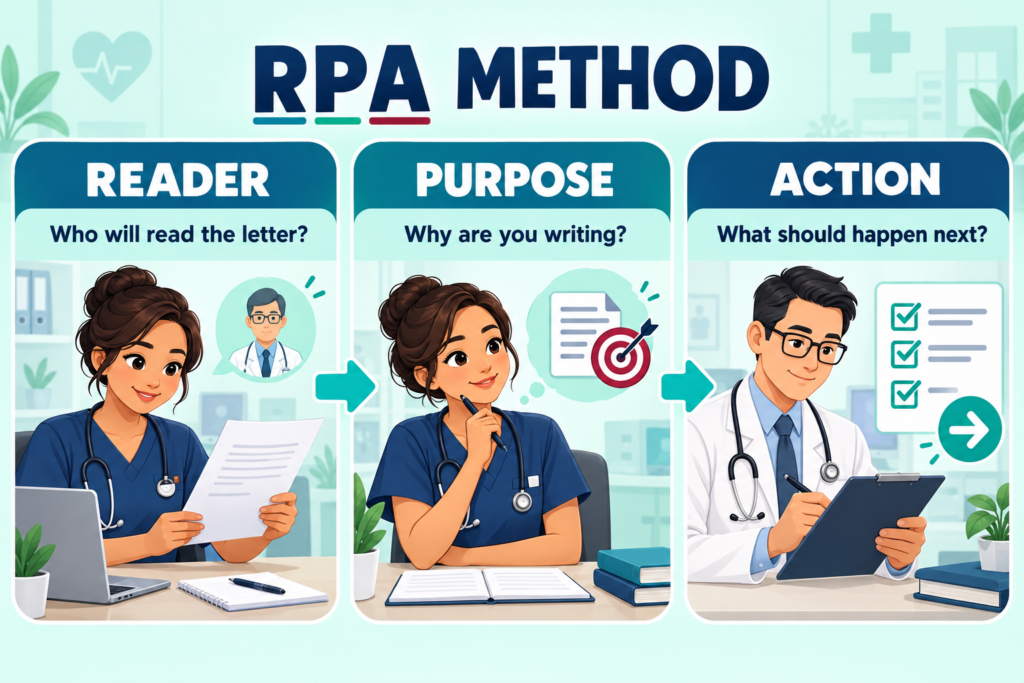
At Outscore English, we call this the RPA method:
- Reader: Who is receiving the letter?
- Purpose: Why are you writing?
- Action: What should happen next?
For example:
Write a discharge letter to Ms Raman’s community nurse requesting continued wound care and monitoring after surgery.
From this task, you can immediately identify:
- Reader: Community nurse
- Purpose: Postoperative transfer of care
- Action: Continue wound care and monitor recovery
This means that the patient’s wound condition, treatment, discharge status and follow-up requirements will be highly relevant. An unrelated childhood illness will probably not be necessary.
Use the SIFT method to select OET Writing case notes
The SIFT method can help you decide what belongs in your letter.
S — Select essential information
Select the details the reader must know to provide safe and effective care.
This may include:
- The patient’s current condition
- The reason for referral or discharge
- Relevant symptoms
- Important test results
- Treatment already provided
- Current medication
- Changes in the patient’s condition
- Follow-up instructions
- Risk factors affecting future care
Ask yourself:
Would the reader’s understanding or actions be affected if I removed this information?
If the answer is yes, the detail should probably be included.
I — Include relevant background
Some past information is useful because it explains the patient’s present condition or future needs.
For example, a history of type 2 diabetes may be relevant when writing about delayed wound healing. However, a minor infection treated successfully ten years earlier is unlikely to help the reader.
Include background information when it:
- Explains the current diagnosis
- Affects treatment or recovery
- Creates an important clinical risk
- Influences medication or follow-up care
F — Filter unnecessary details
Not every note deserves a place in the letter.
You can usually leave out information that is:
- Unrelated to the letter’s purpose
- Repetitive
- Minor and fully resolved
- Already obvious to the reader
- Administrative rather than clinical
- Too detailed for the recipient’s role
For example, a physiotherapist may need information about mobility, pain and physical limitations. They may not need a detailed description of an unrelated dermatological condition.
Filtering does not mean ignoring the case notes. It means making a professional decision about what the reader needs.
T — Tidy and transform the notes
Do not copy case notes directly into your letter. Notes are often abbreviated, fragmented and written in chronological order. Your letter should use complete sentences and organise information according to the reader’s needs.
Consider these case notes:
08/09/26
Pain 7/10
Difficulty walking
Paracetamol ineffective
X-ray: no fracture
Referred for physiotherapy
A clearer version would be:
Ms Lee has experienced increasing knee pain, rated 7/10, which has significantly affected her mobility. Although an X-ray revealed no fracture, her symptoms have not improved with paracetamol. She is therefore being referred for physiotherapy assessment and management.
The rewritten paragraph connects related information and explains why the referral is necessary.
An OET Writing case-note example
Imagine that you are writing to a community nurse following a patient’s discharge.
Case notes
- Mr Somchai Rattanakul, 68
- Admitted with an infected diabetic foot ulcer
- Type 2 diabetes diagnosed in 2014
- Seasonal allergies
- Wound cleaned and dressed daily
- Intravenous antibiotics administered
- Infection improving
- Discharged on oral antibiotics
- Requires dressing changes every two days
- Monitor redness, swelling, discharge and fever
- Review at diabetic clinic in one week
- Enjoys gardening
- Appendectomy in 1998
Information to include
The following details directly support continued care:
- The infected diabetic foot ulcer
- His history of type 2 diabetes
- Wound treatment received
- Improvement in the infection
- Current oral antibiotics
- Dressing-change instructions
- Symptoms requiring monitoring
- Follow-up appointment
Information to leave out
These details do not affect the current purpose:
- Seasonal allergies, unless they affect prescribed treatment
- His interest in gardening
- His appendectomy in 1998
Model paragraph
Mr Rattanakul was admitted with an infected diabetic foot ulcer, which was managed with daily wound cleaning, dressings and intravenous antibiotics. Although the infection has improved, he requires continued wound care following discharge. Please change his dressing every two days and monitor the wound for increasing redness, swelling or discharge. He should also be observed for fever and will attend the diabetic clinic for review in one week.
This paragraph is concise, clinically relevant and focused on the community nurse’s responsibilities.
Common mistakes when selecting OET case notes
Including every detail
A letter filled with unnecessary medical history may hide the information the reader needs most.
Better approach: Prioritise details related to the present condition, purpose and required action.
Removing too much information
Candidates sometimes write an extremely short letter that does not adequately explain the patient’s situation.
Better approach: Include enough background and treatment information to make the request clear.
Listing information without connecting it
A sequence of short facts may sound like copied case notes rather than professional communication.
Better approach: Combine related details and show relationships such as cause, contrast, progress and result.
Following the case-note order automatically
Case notes are usually chronological, but chronological order is not always the clearest structure for the reader.
Better approach: Group information into logical sections, such as:
- Purpose and current situation
- Relevant medical background
- Treatment and progress
- Required care and follow-up
Repeating the same information
Repeating the diagnosis or purpose uses valuable time and makes the letter less concise.
Better approach: State each key point clearly in the most appropriate section.
A quick relevance test
Before including a case note, ask:
- Does it explain the reason for writing?
- Does it affect the patient’s current condition?
- Does it influence treatment or future care?
- Does it tell the reader what action to take?
- Could omitting it create confusion or clinical risk?
If the answer to all five questions is no, the information probably does not belong in the letter.
Final OET Writing tip
Think like the healthcare professional receiving your letter.
The goal is not to show the examiner how many case notes you can include. The goal is to give the reader the right information, in the right order, for the right purpose.
A successful OET letter should allow the reader to quickly understand:
- Why the patient needs their attention
- What has already happened
- What the patient’s condition is now
- What care or action is required next
When every sentence serves the reader and supports the purpose, your writing becomes clearer, shorter and more clinically effective.
Master OET Writing with Outscore English
Do you struggle to select relevant case notes, organise clinical information or write clear referral and discharge letters?
The Outscore English OET Writing Course provides structured preparation specifically for healthcare professionals. You will learn practical techniques for:
- Analysing the reader, purpose and required action
- Selecting relevant case notes
- Organising clinical events logically
- Writing effective introductions and purpose statements
- Improving grammar, clarity and professional tone
- Producing focused referral, discharge and transfer letters
- Checking your work using the official OET Writing criteria

The course includes interactive lessons, realistic healthcare scenarios, model answers, writing activities and practical strategies that you can apply on test day.
Explore Outscore English OET courses for healthcare professionals
Don’t just pass your test. Outscore it.