How to Improve Your Lexical Resource Score in IELTS: A Practical Guide to Band 7+
If you’re aiming for a Band 7 or higher in IELTS, one of the most important scoring criteria is Lexical Resource. Many students mistakenly believe that getting a high score means memorising hundreds of difficult words. In reality, IELTS examiners are looking for something much more practical: your ability to use a wide range of vocabulary accurately, naturally, and appropriately.
In this guide, we’ll explain exactly what Lexical Resource is, how it is assessed, and the best ways to improve it before your IELTS exam.
What Is Lexical Resource?
Lexical Resource refers to your ability to use vocabulary effectively.
The examiner assesses whether you can:
- Use a wide range of vocabulary.
- Choose the correct word for the context.
- Use less common vocabulary naturally.
- Paraphrase ideas instead of repeating the same words.
- Demonstrate accurate spelling and word formation (Writing).
- Pronounce vocabulary clearly and naturally (Speaking).
Vocabulary accounts for 25% of your score in both the IELTS Speaking and Writing tests.
1. Learn Topic-Based Vocabulary
Instead of memorising random word lists, study vocabulary by IELTS topic.
Common IELTS themes include:
- Education
- Environment
- Technology
- Health
- Crime
- Culture
- Travel
- Work
- Food
- Society
For each topic, learn:
- 10–15 useful words
- Common collocations
- Typical adjectives
- Useful verbs
- Natural expressions
For example, instead of simply learning:
Pollution
Learn phrases such as:
- air pollution
- reduce emissions
- renewable energy
- environmental awareness
- sustainable development
- carbon footprint
These sound much more natural than isolated vocabulary.
2. Learn Collocations
Native speakers rarely use words on their own.
They naturally combine words together.
For example:
Instead of saying:
- make research ❌
Say:
- conduct research ✔️
Instead of:
- very happy ❌
Say:
- absolutely delighted ✔️
Other useful examples include:
- heavy traffic
- strong evidence
- reach a conclusion
- tackle a problem
- gain experience
- achieve success
Learning collocations will immediately make your English sound more fluent.
3. Stop Repeating the Same Words
One of the biggest reasons students stay at Band 6 is repetition.
For example:
I like travelling because travelling is fun. Travelling helps me relax when I travel.
Instead:
I enjoy travelling because exploring new places helps me unwind and broadens my perspective.
Notice how the vocabulary varies naturally.
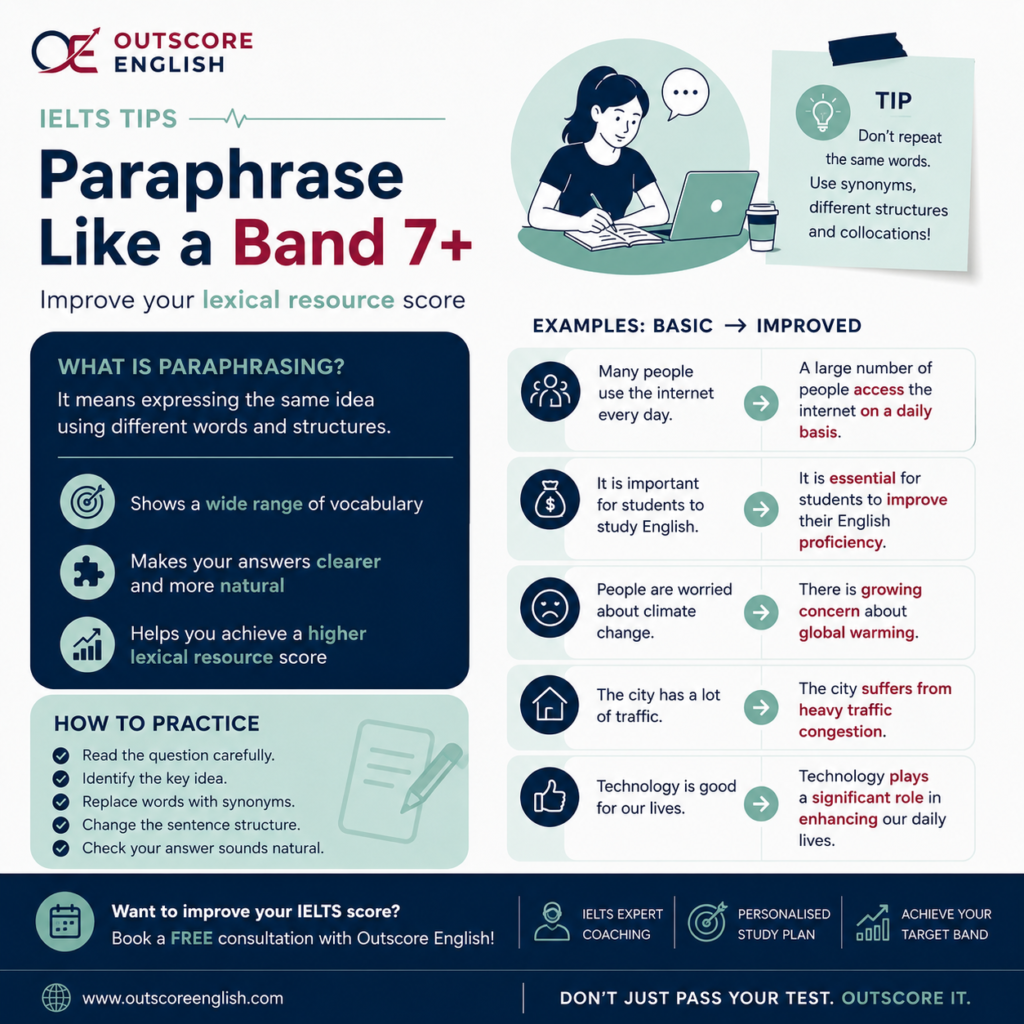
4. Learn to Paraphrase
Paraphrasing is one of the most valuable IELTS skills.
Instead of repeating the same word, use alternatives.
Examples:
Important
- essential
- crucial
- significant
- vital
Big
- enormous
- substantial
- considerable
- massive
Good
- beneficial
- effective
- valuable
- worthwhile
The key is choosing the word that best fits the context—not simply the most advanced word.
5. Use Less Common Vocabulary Naturally
Many students try to impress the examiner with obscure words.
This often has the opposite effect.
Instead of writing:
The weather was clement.
Most native speakers would naturally say:
The weather was pleasant.
Band 7 and Band 8 candidates use vocabulary that is appropriate, not unnecessarily difficult.
6. Read Every Day
Reading is one of the fastest ways to improve your vocabulary.
Excellent sources include:
- BBC News
- National Geographic
- The Guardian
- Scientific American
- IELTS articles
- English blogs
As you read:
- Highlight unfamiliar words.
- Learn common collocations.
- Notice how vocabulary is used in context.
- Create example sentences of your own.
7. Keep a Vocabulary Notebook
Don’t just write single words.
Instead, record:
Word:
Resilient
Meaning:
Able to recover quickly from difficulties.
Collocations:
- resilient community
- resilient economy
- emotionally resilient
Example:
Healthcare workers must remain resilient during stressful situations.
Learning vocabulary this way makes it much easier to remember.
8. Learn Word Families
IELTS rewards flexibility.
For example:
Educate
- education
- educational
- educator
- educated
- educating
Develop
- development
- developer
- developed
- developing
- developmental
Knowing different forms allows you to write and speak more naturally.
9. Practise Using New Vocabulary
Simply recognising words isn’t enough.
Try to use new vocabulary in:
- Speaking answers
- Writing Task 2 essays
- Emails
- Daily conversations
- Journal entries
The more you actively use vocabulary, the more naturally it will come to you in the exam.
10. Learn Vocabulary Through Listening
Watch English content with subtitles.
Great choices include:
- TED Talks
- BBC documentaries
- Podcasts
- YouTube educational channels
Pay attention to:
- Natural expressions
- Idioms
- Collocations
- Pronunciation
- Stress patterns
This improves both your vocabulary and your speaking fluency.
Common Mistakes That Lower Your Lexical Resource Score
Avoid these common errors:
- Memorising long vocabulary lists without understanding them.
- Using words incorrectly.
- Repeating the same vocabulary throughout your answer.
- Overusing idioms.
- Using overly formal or outdated words.
- Translating directly from your first language.
- Ignoring collocations.
Remember: natural English always scores higher than forced “advanced” vocabulary.
Daily Vocabulary Practice Plan
Spend just 20–30 minutes a day:
- Read one English article.
- Learn five new words.
- Learn two collocations.
- Write three example sentences.
- Use one new phrase in a speaking answer.
Consistency is far more effective than cramming hundreds of words the week before your exam.
Final Thoughts
Improving your Lexical Resource score is not about sounding like a dictionary—it’s about communicating clearly, naturally, and confidently. Focus on learning vocabulary in context, mastering collocations, and practising topic-specific language regularly. Over time, you’ll notice that your speaking and writing become more fluent, varied, and accurate.
At Outscore English, we help students build the vocabulary they actually need for the IELTS exam. Through guided speaking practice, personalised feedback, and realistic mock tests, you’ll learn how to use advanced vocabulary naturally—not just memorise it.
Ready to boost your IELTS score?
Book a FREE IELTS Speaking Mock Test and Consultation with Outscore English today. We’ll identify your current band score, explain exactly how to improve your Lexical Resource, and create a personalised study plan to help you reach your target band.
Don’t just pass your IELTS. Outscore it.