
What are the most commonly asked about topics in the IELTS speaking exam?
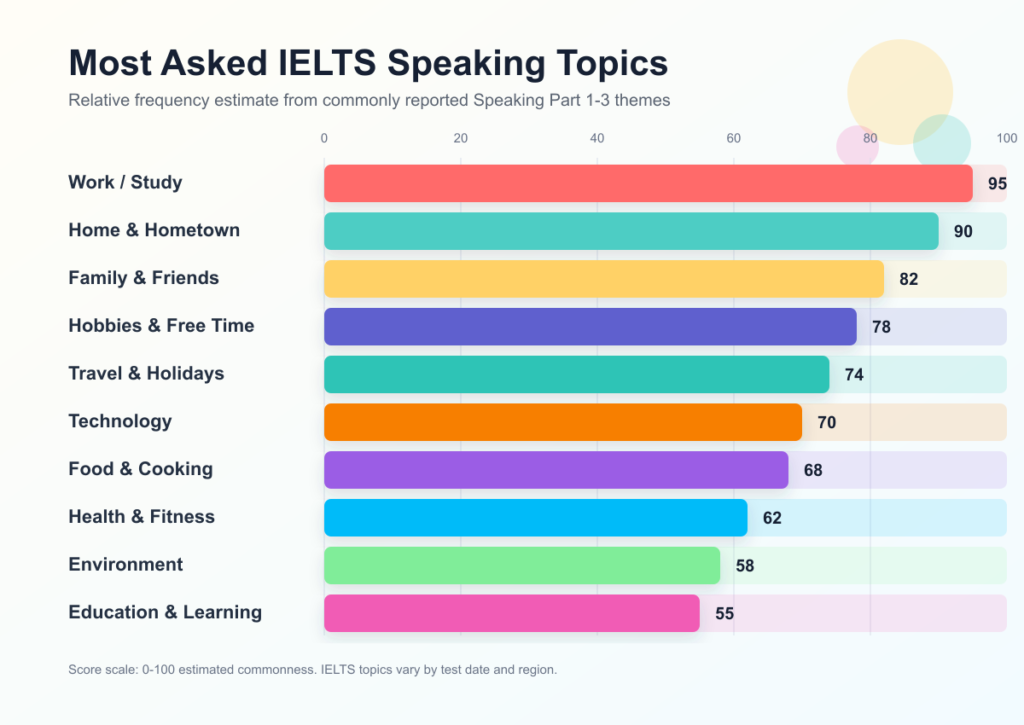
The Most Asked IELTS Speaking Topics (And How to Prepare for Them)
If you’re preparing for the IELTS Speaking test, one of the smartest strategies is to focus on the topics that appear most frequently. While IELTS questions change regularly, certain themes appear again and again across Part 1, Part 2, and Part 3.
The chart above highlights the topics that candidates report most often. The good news? If you can confidently discuss these subjects, you’ll be well prepared for a large percentage of the Speaking test.
1. Work / Study (95%)
This is arguably the most common IELTS topic. Examiners often begin Part 1 by asking about your job, studies, future career plans, or educational experiences.
How to Prepare
- Describe your current job or course.
- Explain why you chose it.
- Discuss future ambitions.
- Practice giving examples from your daily routine.
Vocabulary Word: Aspiration – a strong hope or ambition.
Idiom: Climb the career ladder – to progress in your career.
Example:
“One of my main aspirations is to climb the career ladder and eventually become a project manager.”
2. Home & Hometown (90%)
Questions about where you live are extremely common and often appear at the beginning of the test.
How to Prepare
- Learn to describe your neighbourhood.
- Talk about local attractions.
- Discuss advantages and disadvantages of your hometown.
- Compare past and present.
Vocabulary Word: Bustling – busy and full of activity.
Idiom: A stone’s throw away – very close.
Example:
“The city centre is only a stone’s throw away from my apartment.”
3. Family & Friends (82%)
Relationships are a favourite IELTS topic because everyone can talk about them.
How to Prepare
- Describe family members.
- Talk about a close friend.
- Discuss qualities of good friendships.
- Compare family life today with the past.
Vocabulary Word: Supportive – helpful and encouraging.
Idiom: Through thick and thin – during good and bad times.
Example:
“My best friend has supported me through thick and thin.”
4. Hobbies & Free Time (78%)
Examiners want to hear you speak naturally about activities you enjoy.
How to Prepare
- Discuss hobbies in detail.
- Explain how often you do them.
- Talk about benefits and challenges.
- Compare modern hobbies with traditional ones.
Vocabulary Word: Leisure – free time.
Idiom: Kill time – spend time doing something while waiting.
Example:
“I often read books to kill time during my commute.”
5. Travel & Holidays (74%)
Travel questions frequently appear in all parts of the Speaking test.
How to Prepare
- Describe memorable trips.
- Discuss dream destinations.
- Compare domestic and international travel.
- Explain travel trends.
Vocabulary Word: Destination – the place you are travelling to.
Idiom: Get away from it all – escape daily stress.
Example:
“I enjoy travelling because it helps me get away from it all.”
6. Technology (70%)
Technology is a common Part 3 discussion topic because it encourages deeper opinions.
How to Prepare
- Discuss smartphones and social media.
- Talk about AI and automation.
- Explain benefits and drawbacks of technology.
- Predict future developments.
Vocabulary Word: Innovation – a new idea or development.
Idiom: Keep up with the times – stay modern and updated.
Example:
“People need to keep up with the times by learning new digital skills.”
7. Food & Cooking (68%)
Food is a universal topic that appears regularly in IELTS Speaking.
How to Prepare
- Describe favourite dishes.
- Discuss eating habits.
- Compare home-cooked and restaurant meals.
- Talk about healthy eating.
Vocabulary Word: Cuisine – a style of cooking.
Idiom: Spice things up – make something more interesting.
Example:
“I like trying new cuisines because they spice things up.”
8. Health & Fitness (62%)
Health-related questions are increasingly common, especially in Part 3.
How to Prepare
- Talk about exercise habits.
- Discuss healthy lifestyles.
- Explain public health issues.
- Give opinions on modern diets.
Vocabulary Word: Well-being – overall health and happiness.
Idiom: Fit as a fiddle – very healthy.
Example:
“My grandfather is still fit as a fiddle despite being in his seventies.”
9. Environment (58%)
Environmental topics often appear in more advanced Part 3 discussions.
How to Prepare
- Learn vocabulary related to climate change.
- Discuss recycling and pollution.
- Explain environmental challenges.
- Offer possible solutions.
Vocabulary Word: Sustainability – using resources responsibly.
Idiom: Go green – become environmentally friendly.
Example:
“Many companies are trying to go green by reducing waste.”
10. Education & Learning (55%)
Education often overlaps with work, technology, and future goals.
How to Prepare
- Discuss your learning experiences.
- Compare online and traditional learning.
- Talk about important school subjects.
- Give opinions about education systems.
Vocabulary Word: Curriculum – the subjects taught in a course.
Idiom: Learn the ropes – learn how something works.
Example:
“It took me a few weeks to learn the ropes at university.”
Final Tips from Outscore English
Many IELTS candidates make the mistake of memorising answers. Instead, focus on building topic-specific vocabulary, natural idioms, and the ability to give extended answers with examples.
A simple formula that works well for Band 7+ candidates is:
Opinion → Explanation → Example → Result
For example:
“In my opinion, technology has improved communication. This is because people can connect instantly across the world. For instance, I regularly video call my family overseas. As a result, maintaining relationships has become much easier.”
At Outscore English, we recommend creating a vocabulary notebook for each of these ten core topics. Learn 5-10 advanced words and 2-3 natural idioms per topic, then practise using them in Part 1, Part 2, and Part 3 answers.
The more familiar you become with these high-frequency IELTS themes, the more confident and fluent you’ll sound on test day—and confidence is often the key to unlocking a Band 7+ score. 🚀
Outscore English
Outscore your competitors. Stand out.