IELTS Speaking Exam 2026: Recent Questions Reported by Test Takers
Published by Outscore English
If you’re preparing for the IELTS Speaking test in 2026, you’ll be pleased to know that many topics are repeated throughout the year. While IELTS does not publish official question lists in advance, candidates around the world often report the topics they were asked after completing their exams. These reports provide valuable insight into the kinds of questions you may encounter.
Below is a collection of recently reported IELTS Speaking topics and questions from 2026 to help you prepare more effectively.
IELTS Speaking Part 1
Part 1 lasts around 4–5 minutes and focuses on familiar topics about your daily life.
Recent topics reported by candidates include:
Hometown
- Where is your hometown?
- What do you like most about your hometown?
- Is it a good place for young people?
- How long have you lived there?
- Would you like to continue living there in the future?
Work or Studies
- Do you work or study?
- What do you enjoy about your job?
- What would you like to change about your workplace?
- Why did you choose your field?
Humour
- What makes you laugh?
- Do you enjoy making other people laugh?
- Have you watched any funny films recently?
- Do you think a sense of humour is important?
Fixing Things
- Can you repair things yourself?
- What kinds of things have you fixed?
- Would you like to learn more practical skills?
- Is repairing things an important life skill?
Other frequently reported Part 1 topics in 2026 include:
- Sleep
- Apps
- Technology
- Food
- Travel
- Photography
- Reading
- Sports
- Shopping
- Friends
- Family
- Weekends
- Music
- Public transport
- Weather
- Parks
IELTS Speaking Part 2 (Cue Card)
In Part 2, you’ll receive a topic card and have one minute to prepare before speaking for up to two minutes.
Some of the most commonly reported cue cards in 2026 include:
Describe a person who has influenced your career.
You should say:
- Who the person is
- How they influenced you
- What you learned from them
- Why they are important to you
Describe a time you used a map to find your way.
You should say:
- Where you were
- Why you needed the map
- Whether it was successful
- How you felt afterwards
Describe an environmental law in your country.
You should say:
- What the law is
- Why it was introduced
- Whether people follow it
- Why you think it is effective (or ineffective)
Describe a piece of traditional clothing you wore.
You should say:
- What it looked like
- When you wore it
- Why you wore it
- How you felt wearing it
Describe a crowded place you visited.
You should say:
- Where it was
- Why it was crowded
- What happened there
- Whether you enjoyed the experience
Other popular cue card themes reported this year include:
- A useful skill you learned
- A memorable journey
- A favourite book
- A person who helped you
- A useful website or app
- A piece of technology
- An interesting conversation
- A time you solved a problem
- A historical place
- A beautiful natural location
IELTS Speaking Part 3
Part 3 contains more abstract discussion questions related to your cue card topic.
Some recently reported discussion questions include:
Technology
- Will artificial intelligence replace many jobs?
- How has technology changed education?
- Should schools use more AI tools?
Environment
- Should governments spend more money protecting nature?
- Can individuals make a difference?
- Why do some people ignore environmental issues?
Culture
- Is it important to preserve traditional clothing?
- How has culture changed in recent years?
- Should young people learn more about traditions?
Travel
- Why do people enjoy travelling?
- Will international travel continue to grow?
- What are the disadvantages of tourism?
Careers
- How should young people choose a career?
- Are salaries more important than job satisfaction?
- Will remote work become more common?
What Do These Questions Tell Us?
Although the exact wording changes from test to test, clear patterns appear every year.
In 2026, IELTS has continued to focus on everyday topics such as:
- Technology and AI
- Environmental issues
- Personal experiences
- Work and education
- Culture and traditions
- Travel
- Maps and navigation
- Problem-solving
- Community and society
Rather than memorising answers, prepare flexible vocabulary and personal examples that you can adapt to different questions.
How Should You Prepare?
The highest-scoring candidates don’t memorise scripts. Instead, they practise speaking naturally about a wide variety of everyday topics.
To improve your score:
- Practise speaking for two minutes without stopping.
- Build topic-specific vocabulary and collocations.
- Learn how to paraphrase questions.
- Record yourself and listen for repetition or hesitation.
- Complete regular mock speaking tests under timed conditions.
Remember, the examiner is assessing your fluency, lexical resource, grammar, and pronunciation—not whether you’ve memorised the “correct” answer.
Final Thoughts
Recent candidate reports suggest that IELTS Speaking in 2026 continues to focus on practical, real-life situations rather than obscure or specialist knowledge. If you’re comfortable discussing everyday experiences, giving opinions, and supporting your ideas with examples, you’ll be well prepared for test day.
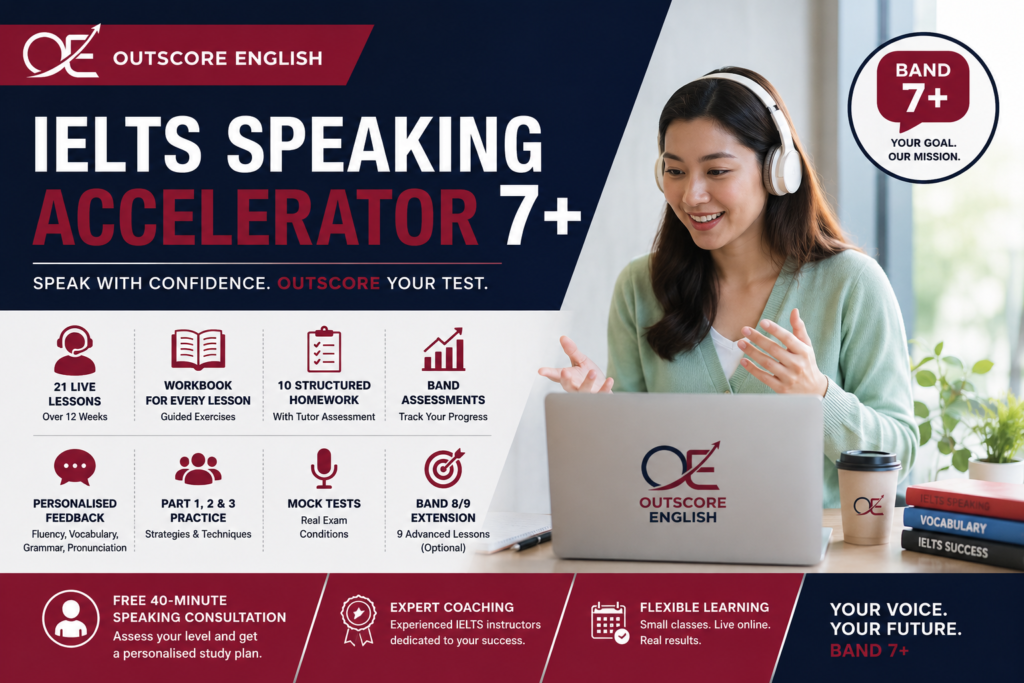
At Outscore English, our IELTS Speaking Accelerator is designed around the latest exam trends. You’ll practise with realistic mock tests, receive personalised feedback from experienced teachers, and learn the techniques needed to achieve Band 7 or higher.
Book your FREE IELTS Speaking Mock Test and discover your current band score today.
Join our Speaking Accelerator band 7 + Live 1 on 1 lessons today. On sale from July-September. Book by Lesson on our IELTS Tutoring Page for immediate booking and Zoom Invitation. Limited batch of 50 students.
Don’t just pass your IELTS. Outscore it.